

The U.S. Episcopal Church (the Anglican body in the United States created in 1785) was banned for three years from decision-making positions within the Anglican Communion.
Following an extraordinary meeting of Anglican leaders held on 14 January 2016, the role of the American Episcopal Church was temporarily restricted in their global fellowship and at ecumenical and interfaith decision-making level – all these because of the acceptance of gay marriages by the Episcopal Church.
Anglicans, with roots in the Church of England’s missionary work, are the third-largest group of Christians in the world, behind Roman Catholics and the Orthodox. They include 85 million members living in 165 countries, 3.5 million members being part of the U.S. Episcopal Church.
Background
The historical sanction was taken at Canterbury, England, where the Archbishop of Canterbury, Justin Welby, had to take radical decisions in the context in which a division of the Global Anglican Mission was created, because of the Episcopalians who voted to officialize same-sex marriages.
Welby could not force a compromise, despite the fact that the meeting of Anglican leaders held on 14 January was attended also by the representative of the Episcopal American Church, Michael Curry, who warned the other leaders that their vote “will bring real pain” for all Episcopalians, but especially for lesbian, gay, bisexual and transgender members.
Archbishop of Canterbury’s decision was claimed by the theologically conservative Anglican leaders who sought sanctions against the U.S. Episcopal Church, otherwise threatening to leave the international meeting. About two-thirds of the 37 archbishops at the meeting voted to sanction the American branch.
-
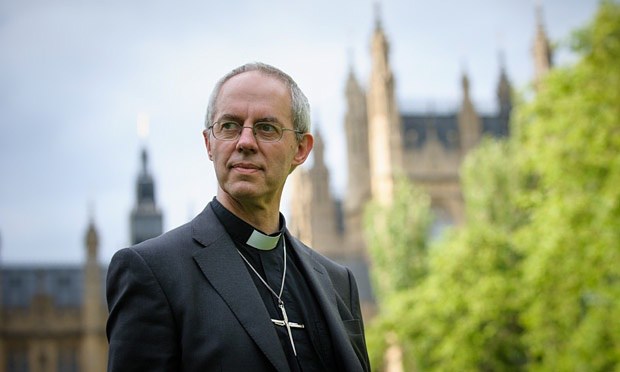
- Archbishop of Canterbury, Justin Welby – the leader of the Anglican Church.
-
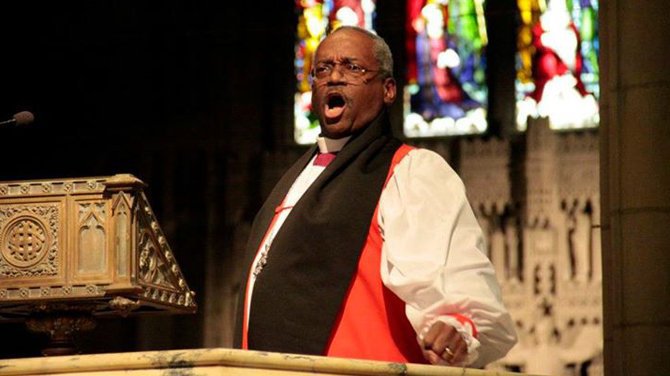
- The leader of U.S. Episcopal Church, Michael Curry.
-

- To the right: the first consacrated gay bishop of the Episcopal Church, Gene Robinson.
The world mission of the Anglican Church has experienced in the last 13 years a number of “cracks” because of different visions about gay relationships, ordination of women and other related issues. But the “fracture” was provoked in 2003 when the New York-based Episcopal Church consecrated the first openly gay bishop, Gene Robinson, in New Hampshire. Also in June 2015, the same church decided in the General Convention to change the language of defining marriage (before this date marriage being defined as “a physical and spiritual union of a man and a woman” – see Resolution A036), thereby authorizing gay marriages – see Resolution A054.
The Episcopal Church says, inter alia, that its “convention honors the theological diversity of this Church in regard to matters of human sexuality; and that no bishop, priest, deacon or lay person should be coerced or penalized in any manner, nor suffer any canonical disabilities, as a result of his or her theological objection to or support for the 78th General Convention’s action contained in this resolution; and be it further”.
Internal pressures
The hand of the Archbishop of Canterbury was forced not only by the tireless criticism of the traditionalists leaders but also by the fact that Anglican conservatives from the entire world have joined together to organize The Global Anglican Future Conference – a sign of their distancing from the U.S. Episcopal Church and their refusing to participate in some Anglican gatherings.
Because of the Archdiocese of Canterbury’s delayed reactions, in 2009, conservative Anglican leaders created the Anglican Church in North America as a conservative theological alternative to what was happening in the U.S. Episcopal Church.
-
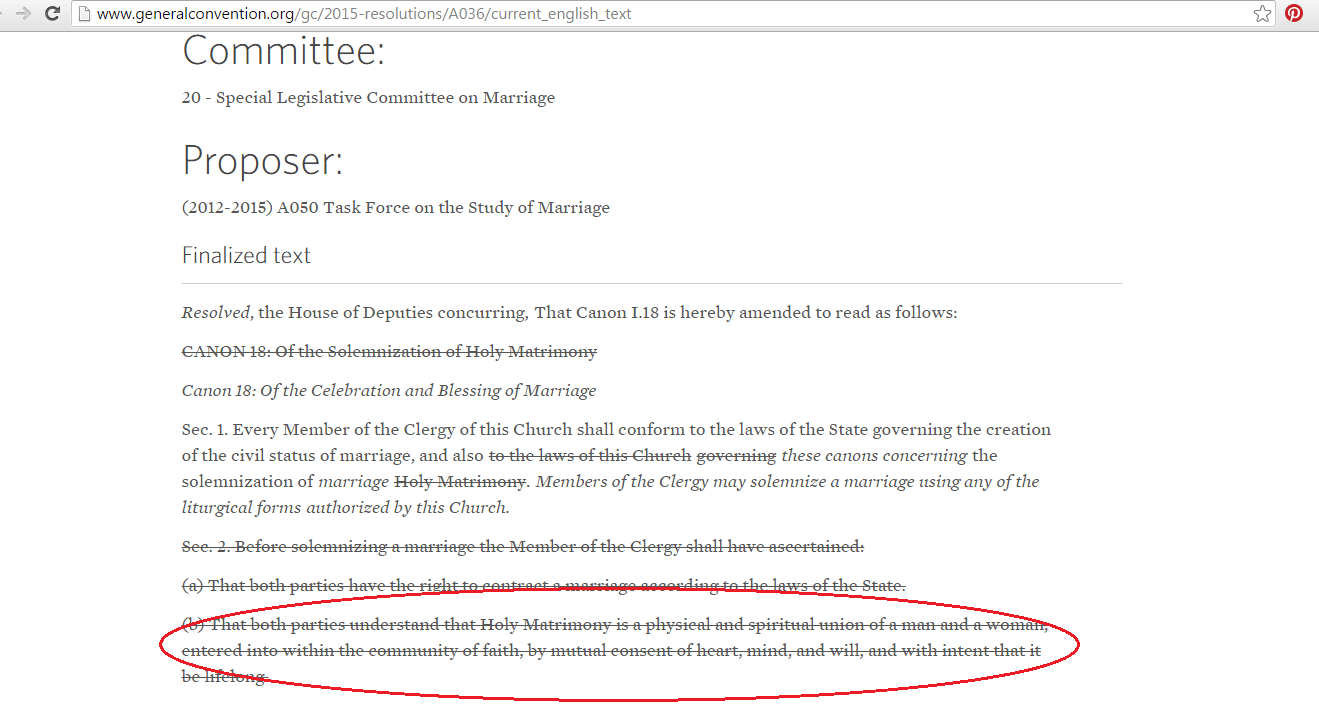
- Resolution A036 of the Episcopal Church concerning the review of the language of marriage.
-
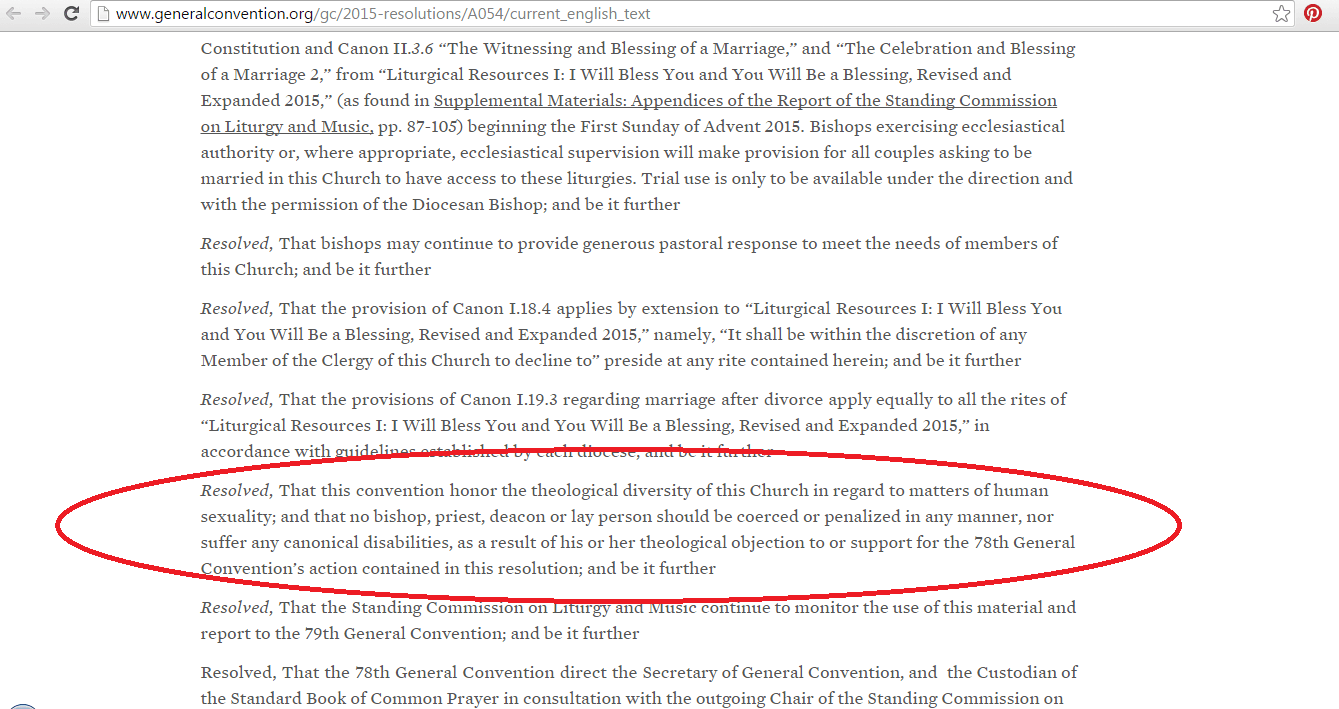
- Resolution A054 of the Episcopal Church concerning the review of the language of marriage.
-
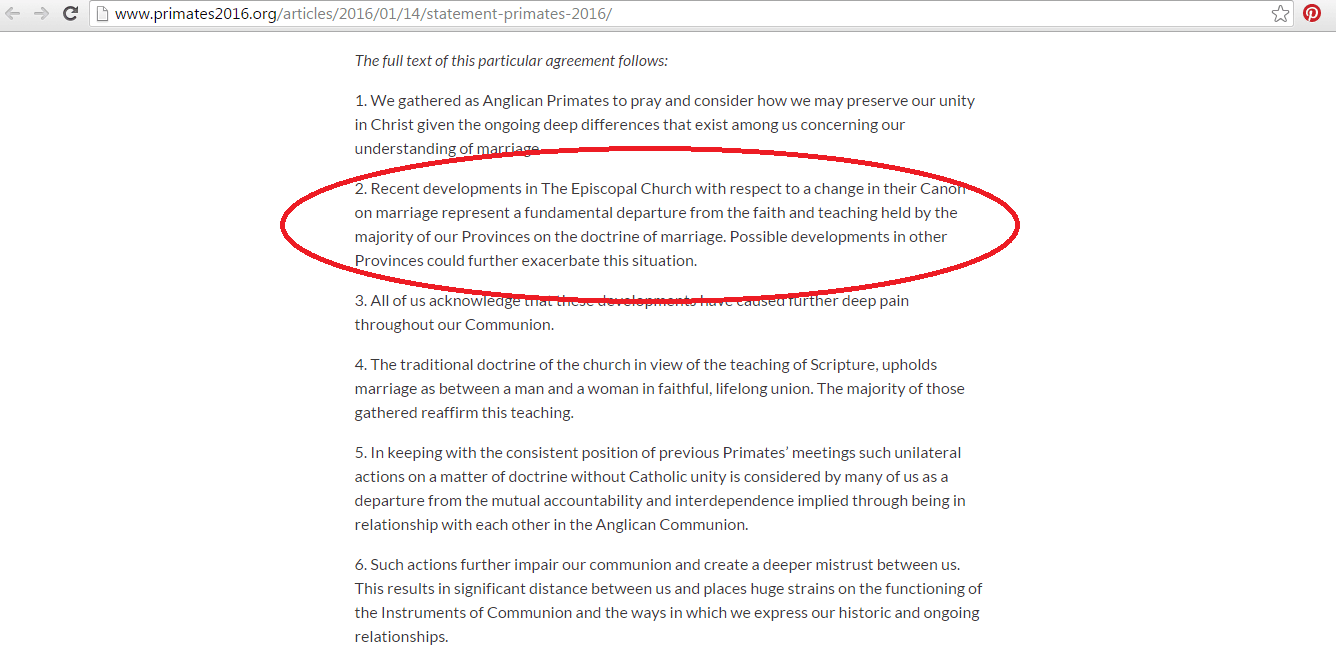
- The decision to sanction the US Episcopal Church – the press office of the Anglican leaders.
Justin Welby was forced on 14 January 2016 to also invite the leader of Anglican Church in North America at the extraordinary meeting, a churh which counts just over 100,000 members.
The U.S. Episcopal Church has been facing criticism, it showing “a fundamental departure from the faith and teaching held by the majority of our Provinces on the doctrine of marriage”, the press office of the Anglican leaders saying that Episcopalians “no longer represent us in ecumenical and interfaith bodies”, their status being reduced to the equivalent of observers at the Anglican committees, where “they will not take part in decision making on any issues pertaining to doctrine or political system”.
The most vocal protests against the Episcopalians’ embracing of gay rights came from Africa, home of the fastest-growing churches in the Anglican communion. Archbishop Stanley Ntagali, the representative of the Anglican Church in Uganda, said after the extraordinary meeting held in Canterbury that “this action must not be seen as an end, but as a beginning (…) of discipline and godly order”, the Africans having the deepest opposition to gay relationships as a violation of Scripture.
Reactions after applying the sanction
- Following the historical decision of penalizing Episcopalians, the press office of the Anglican leaders reconfirmed that “it is our unanimous desire to walk together”, despite “the ongoing deep differences that exist among us concerning our understanding of marriage”, the majority of those gathered reaffirming the teaching that says: “The traditional doctrine of the church in view of the teaching of Scripture, upholds marriage as between a man and a woman in faithful, lifelong union”.
- In response to the disciplinary sanctions of the Episcopal Church suspension of powers, the first consecrated gay bishop, Gene Robinson, posted on Twitter the following message: “God’s judgment against those who include too many will be less harsh than the judgment against those who include too few“.
-
-
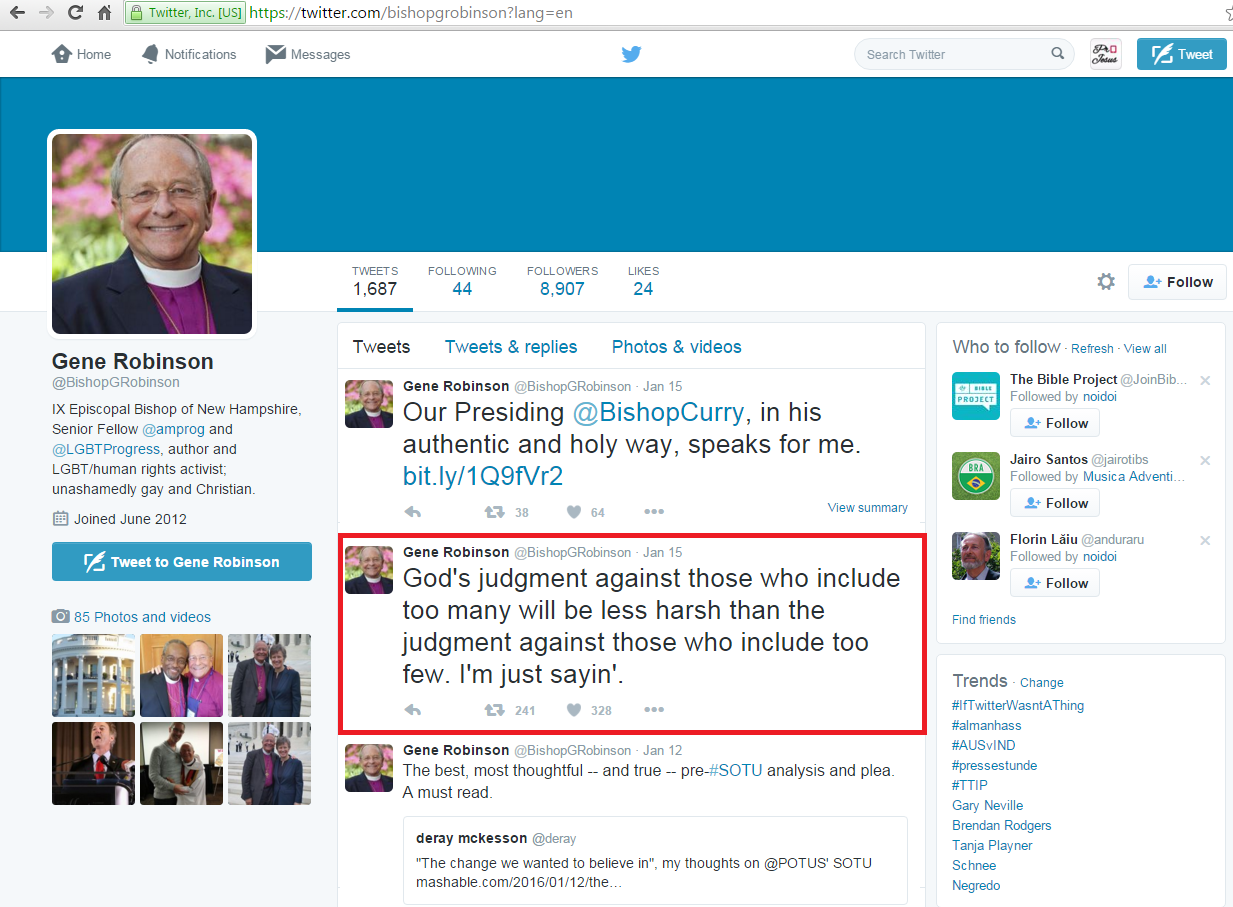
- The post of Bishop Gene Robinson (Twitter).
-
- Also, the representative of the Episcopal Church in the U.S.A., Michael Curry, said: “Our commitment to be an inclusive church is not based on a social theory or capitulation to the ways of the culture, but on our belief that the outstretched arms of Jesus on the cross are a sign of the very love of God reaching out to us all. While I understand that many disagree with us, our decision regarding [gay] marriage is based on the belief that the words of the Apostle Paul to the Galatians are true for the church today: “All who have been baptized into Christ have put on Christ. There is no longer Jew or Gentile, slave or free, male or female, for all are one in Christ”(…). For many who have felt and been rejected by the church because of who they are, for many who have felt and been rejected by families and communities, our church opening itself in love was a sign of hope“.
Other challenges
Besides the US Episcopal Church that authorized gay marriages, other Anglican national churches (as those from Brazil, South Africa, New Zealand and Scotland) have taken steps toward accepting same-sex relationships.
Furthermore, in July 2016, the top body of the Anglican Church of Canada will decide whether to authorize gay marriage or not. Its representative has declined to comment on the recent decision of Anglicans, particularly given the proposal to Canadians to repent and “voluntarily withdraw” from the pro-gay vote.
Meanwhile, in an effort to break the bitter impasse that has divided the Anglican Communion, the archbishop of Canterbury asked to appoint a task group “to maintain conversation among ourselves with the intention of restoration of relationship, the rebuilding of mutual trust, healing the legacy of hurt, recognizing the extent of our commonality, and exploring our deep differences, ensuring they are held between us in the love and grace of Christ”.
Pro Jesus’ sources:
Davies M., „Majority of primates call for temporary Episcopal Church sanctions”, Episcopal News Service, January 14, 2016
Goodstein L., De Freytas-Tamura K., „Anglican Church Disciplines U.S. Episcopals Over Gay Marriages”, New York Times, January 14, 2016
Zoll R., „Anglicans sanction US Episcopal Church over gay marriage”, Yahoo News, January 14, 2016
***, „A054 Adopt Resources and Rites from “Liturgical Resources I: I Will Bless You and You Will Be a Blessing, Revised and Expanded 2015”, The General Convention of the Episcopal Church, 2015
***, „A036 Amend Canon I.18 Marriage”, The General Convention of the Episcopal Church, 2015
***, „News from Primates 2016”, Primates2016.org, January 14, 2016
96
Be smart,
Be elevated.
Pro Jesus